

Resolving Chronic Fatigue
If you've been sick for years and you're still chasing the next test, the next supplement, the next specialist — I want you to meet Amelia.
She spent over two years searching before she got a diagnosis. By the time she found me, she was on 14 prescriptions and 14 more supplements, and none of it was working. Getting her better didn't mean adding another protocol. It meant taking almost everything away and starting over.
In this conversation, Amelia and I talk through what four years of chronic illness actually looked like — the misdiagnoses, the medication she needed to come off of, the medication she needed to go back on, and the parts of her recovery that had nothing to do with a prescription pad at all.
.
Jump to a section — each link opens the video at that moment.
Hiking a Volcano After Years of Chronic Illness
Amelia recently hiked an Icelandic volcano. Steep climb, one step at a time, remembering to breathe.
Two years ago, she couldn't have imagined doing that.
She and her husband had wanted to take that trip years earlier. They waited on purpose — she knew she wouldn't have been well enough to enjoy it. When she came back to work with me in August of 2023, she was, in her own words, a mess. Dull. Sedated. Overmedicated. Oversupplemented.
The volcano wasn't just a vacation. It was proof of how far she'd come.
Misdiagnosed and Over-Medicated for Years
Amelia's symptoms started in December of 2019. It took two and a half years to get a diagnosis — mold toxicity, in the spring of 2022.
While she searched, she was working with a psychiatrist for what looked like anxiety, depression, and mood issues. To his credit, he told her to keep looking — he suspected something medical was underneath it, not a primary mental health condition.
By the time she found me, the math was ugly:
14 prescriptions, layered on by multiple well-meaning doctors
14 or more supplements, stacked on top of that
Medication to wake her up. Medication to help her sleep. As she put it, her whole life felt fake — nothing happened without a pill triggering it first.
She'd also been treated for Lyme disease for four months, April to August of 2022 — oral antibiotics, no IV treatment. It didn't help. In my experience, that's common. Lyme protocols like that one tend to hammer the gut without addressing what's actually driving the illness, and a damaged gut makes everything else harder to fix.
Headaches. Exercise intolerance. Constipation. Brain fog. Depression. Pain. She wasn't getting better — she was accumulating treatments.
The first move wasn't a new prescription. It was pulling almost all of them back off.
Restarting Clonazepam to Fix Benzodiazepine Withdrawal
Benzodiazepines are useful, and they're also habit-forming — which is why both doctors and patients tend to be nervous around them. Amelia had been fully tapered off hers before we started working together.
She didn't do well off of it.
The first attempt to stop produced two weeks of classic withdrawal — horrible diarrhea, GI pain, dizziness, brain fog. She pushed through, expecting the GI symptoms to resolve once withdrawal ended. They didn't. They became something she had to plan her life around.
We restarted her on a quarter milligram of clonazepam. Her stools firmed up. The abdominal pain and fatigue resolved.
I bring this up because I still see it constantly. I had a patient just yesterday who's been off her benzodiazepine for two full years and has been struggling the whole time. We don't reach for these medications if we don't have to — but sometimes brain chemistry needs them, at least for a while.
Amelia didn't need the clonazepam forever. We rebuilt her system slowly, bit by bit, and she's off it completely now. That's the outcome we're always working toward — not staying on the medication, and not forcing it off before the body's ready either.
Environment, Diet, and Doctor Humility in Recovery
Once the medications and supplements came off, we had to find out what Amelia's body actually needed — not what a lab value said it needed.
A few things mattered more than any prescription:
Environment. She and her husband moved to a spot outside the city, closer to nature. She watches turkeys and deer from her kitchen while she eats breakfast. Humans are built to be around greenery — take that away and we don't function as well, no matter what else you fix.
Diet. We tried a high-protein diet. It backfired — she felt like she was gorging herself and couldn't sustain it. We scaled it back to what she could actually manage without forcing it.
Allergy management. Persistent red, itchy eyes never fully resolved with antihistamines. We're now looking at allergy drops as a next step — lower cost, done at home, and I've seen strong results in another patient within two months. Historically I'd have leaned toward injections since the evidence base is older, but the case reports on drops are piling up.
Here's the harder lesson, and it's one I want other doctors to sit with: not every treatment works, and that's fine.
I don't know everything walking into a visit. I offer my best idea of what should help, and then I watch whether it actually fits Amelia's body. Sometimes it does. Sometimes it doesn't. The measure isn't whether a lab test improved — it's whether the patient's symptoms improved. If they didn't, that's not failure. That's information: wrong system, wrong treatment, or wrong time.
Patients get hurt by the opposite belief — that if the protocol isn't working, the answer is to push it harder. Amelia had internalized that herself. She stayed on a binder protocol from a previous doctor for two extra months, making herself sicker, because she didn't want to seem non-compliant. That instinct is exactly backward. Symptoms are the body's feedback. Listen to them.
Trauma, Somatic Experiencing, and Life After Illness
A diagnosis feels like the finish line. It isn't. It's a means to one.
Functional medicine has a bad habit of treating a positive test result as the end of the work. It rarely is. I've had patients walk in reciting a list of diagnoses and tell me they're still not better — because a diagnosis tells you what's wrong, not how to fix it. What patients need after that is a strategy, and often a different guide than the one who found the diagnosis in the first place.
Amelia's advice to anyone still in the search: don't be afraid to switch doctors. Finding the person who diagnosed you doesn't mean they're the person who can get you well.
Chronic illness this severe often comes bundled with a trauma history — rough childhoods, neglect, difficult relationships. Amelia worked through hers in weekly-to-biweekly sessions with a counselor throughout her illness. EMDR was tried first and it was too much — it drained her and set her back physically every time. Somatic experiencing worked instead. Gentler on the body, and she could do it as often as she needed without paying for it physically afterward.
There was a clear turning point. October 27th, 2023 — I wrote it down and highlighted it in green in her chart. Excellent visit. Smiling and happy on the video consult. Sleeping better. More energetic. It was her first trip back to North Carolina in years, and it was the first time she let herself think: maybe I'm actually going to get better.
Now that she is well, she's facing a different problem — figuring out who she is without an illness organizing every decision. She calls it an identity crisis, and also a blessing: she gets to dream again, plan again, without knowing exactly what comes next.
If you've been sick long enough that you've forgotten what planning a future feels like — that feeling comes back. It came back for Amelia. It can come back for you too.
Watch the full video here: Reversing Chronic Fatigue
If you or someone you love is stuck in a years-long search for answers, share this with them. Sometimes the most important thing a doctor can tell you isn't a new diagnosis — it's permission to stop, subtract, and start over.
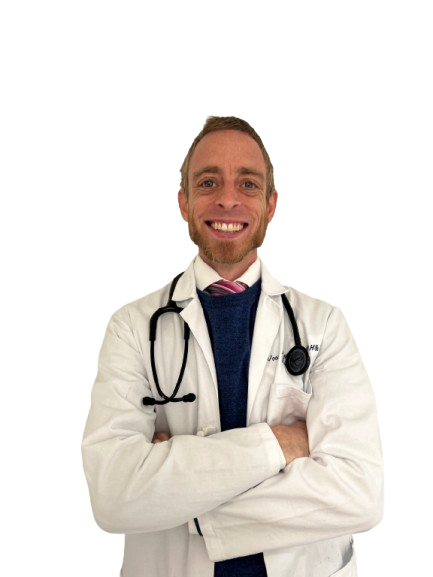
Dr. Joe Mather MD, MPH&TM
I am a Medical Doctor practicing in New Orleans, and hold medical licenses from the states of Louisiana and Texas. I am board certified by the American Board of Family Medicine and have been practicing functional medicine for over a decade.
Because so many people struggle for years trying to recover their health, often spending thousands of dollars chasing dead ends, I'm passionate about making functional medicine cost-effective and practical.
I graduated from the Tulane University School of Medicine and the School of Public Health in 2011 and completed my training in Family Practice in 2014. I treat many conditions but have expertise working with chronic GI symptoms, mold and heavy metals and in preventative cardiac care.
Would you like more information, or to schedule an appointment?